The ambitions being published for AI reach well beyond better software. Sam Altman's The Gentle Singularity describes cheap intelligence and robots helping build more industrial capacity 1. Dario Amodei's Machines of Loving Grace explores possible gains in health, science and human life 2. China's AI Plus initiative sets out ambitions across industry, science, public services and governance 3. The US AI Action Plan promotes AI-enabled science, manufacturing and infrastructure, while promising to complement rather than replace people's work 4.
These are different visions and policy aims, not one agreed destination or evidence that it will arrive. For The Frontier, they offer a starting place for exploring what could become possible and how life might change. This report distils that exploration into five explicit assumptions. It asks what would follow if they held, what else would need to happen, and what we might observe if they were wrong. No single document endorses the whole set.
The five assumptions are not a forecast, a consensus or a sequence that must unfold in order. They are conditionals: a way of holding an ambitious idea still long enough to examine it. Some could hold while others fail. Much of what is interesting lies in those combinations, and in the many places where the outcome depends less on what machines can do than on what people choose to do with them.
The Five Assumptions
The map assumes humans broadly retain control over these systems. That is a boundary for this inquiry, not an assurance that the control problem is solved. If control failed, the social paths explored here would no longer be a reliable guide.
A1: Copyable expertise. AI performs essentially all the cognitive work that experts do today, at a marginal cost approaching the cost of energy, for a fixed level of capability. The qualifier matters. The newest, most capable systems may remain expensive. What becomes cheap is a given level of expertise once it has been reached.
A2: Accelerated discovery. Hypothesis generation, design and analysis become dramatically faster. That does not mean every part of science speeds up equally. Physical experiments, validation and clinical trials may remain bottlenecks, and no particular breakthrough is guaranteed.
A3: AI develops AI. Automated AI researchers drive most of the improvement in the next generation of AI systems. This is an assumption about a mechanism, not a delivery date. It is also less than full, autonomous recursive self-improvement. Anthropic, for instance, writes that full recursive self-improvement has not happened and is not inevitable, and that large gaps remain in its systems' judgement about which goals to pursue 5.
A4: Embodied intelligence. Robots of many forms (industrial, mobile and specialised as well as humanoid) perform most of the physical work that now requires people, at falling unit cost. "Unit cost" here means full cost: energy and capital, plus maintenance, integration into real workplaces, supervision, and responsibility when something goes wrong.
A5: Self-expanding industry. Together, the first four allow production systems to build much of their own additional capacity: factories, mines, power stations, chip plants and data centres. This is the boldest step in the set. None of the examples cited here demonstrates its full scope. A software loop in which AI writes much of the code for the next AI does not establish it. Mines, fabs and power grids depend on materials, land, permits and physical construction.
A5 combines capabilities: expertise and physical work would have to connect with research, design and the construction of new capacity. The earlier assumptions do not prove that this combination will work. If it did, machines could do more of the work of designing, building and maintaining other machines, rather than creating new work for people at each expansion. That could change both the scale of production and how its gains reach people.
Reading claims about the frontier
Two distinctions help with almost any claim about AI, including those in this report.
Capability is not deployment, and deployment is not permission. A system that performs a task in a laboratory has not thereby done it in a hospital or on a building site. Deployment needs money, integration, training and trust. Permission needs regulators, courts, planning authorities and customers to accept the result. Each moves at its own pace.
More output is not the same as more productivity, or more welfare. Anthropic reports that Claude wrote more than 80 percent of the code merged into its codebase as of May 2026. That is an authorship share, not a measured productivity gain. Its separate growth-in-code-output measure comes with a warning that quantity overstates productivity, and the company describes human code review becoming a bottleneck 5. These are company-reported observations. Speed in one step can move the constraint elsewhere.
Where the paths lead
Expertise and hands
If A1 holds, the first change many people notice might be availability rather than unemployment. Help that today depends on income could become cheap enough to offer at any moment and in many languages: a lawyer reading a contract, a doctor interpreting a test, an engineer checking a plan. Add A4, and physical help could follow, from repairs and building to care and transport.
One intriguing implication is that individuals and small groups might do things that once needed an organisation: build a house, run a research project, manage a farm, produce a film. Organisations would still be needed for infrastructure, law and collective decisions. People might simply need them less to live a capable life.
Each step has conditions. Advice is not enforcement: a well-founded objection to a landlord or an agency helps only if it can be heard and acted on. Whether a household can use robotic help depends on purchase price, finance, rental and service terms, and whether the equipment is available locally. Renting can widen access, but contracts can also lock people in. Cheaper construction does not by itself decide who gets housing, because land, permits, grid connections and lending terms still apply. Access could also split, with adequate, inexpensive capability for most people and frontier capability for those who can pay more.
Discovery: science, materials and health
A2 opens some of the most appealing possibilities. If design and analysis become much faster, researchers could explore more candidate molecules, materials and experimental designs. That could matter for medicines and diagnostics, and for materials and energy technologies. In each field, synthesis, testing, approval and manufacture would still set much of the pace. One possibility worth watching is whether cheaper research makes neglected rare conditions more viable targets.
Consider a researcher looking for a material that is light, strong and tolerant of heat. More capable design tools could help compare candidates, identify trade-offs and choose which measurements would distinguish promising ideas. The useful outcome need not be a spectacular new substance. It could be a less wasteful process or a material that lasts longer. These are illustrations of the assumption, not claims that AI has already delivered them.
There is another possibility here: a small team could investigate a question that previously required a much larger institution. Cheaper analysis might make an unusual research direction affordable, or allow more competing explanations to be tested on the same observations. The question is whether more ideas become good experiments and useful results, rather than simply more output. That gives us something to follow between dramatic announcements.
Useful medical progress does not require solving ageing. A more ambitious scenario is a substantial extension of healthy life. That would require biological approaches that actually work, safe and measurable clinical benefits, and treatments people can afford and obtain. Better simulation and automated laboratories might help, without eliminating physical experiments or long-term observation. If healthy life did lengthen, alongside affordable physical assistance at home, pensions, care and the familiar sequence of education, work and retirement would need rethinking. Medicine could still advance considerably without that scenario.
Factories, scarcity and limits
A5 points to a less obvious shift: what remains scarce. If factories, power plants and standard housing become capacity that automated systems can reproduce wherever energy, materials and permits allow, today's advantages in manufacturing, energy and frontier models start to look like starting positions rather than permanent positions. Scarcity would move towards things that cannot be copied:
- particular locations;
- ecological limits;
- rights and permits;
- trust and legitimacy;
- human attention and presence.
That would be a different map of power from today's. Nothing in it names an inevitable winner among countries. Some advantages could be reproduced elsewhere, while others could be prolonged by export controls, scarce inputs or early political consolidation.
Some limits are physical. The International Energy Agency estimates data-centre electricity use at around 415 TWh in 2024, around 945 TWh in 2030 in its base case, and between 700 and 1,700 TWh across its cases in 2035 6. These are dated projections for today's trajectory, not estimates for a world where the five assumptions hold. In such a world, energy demand would depend more on how much production societies chose to pursue. The same self-expanding capacity could also build new generation, if permits, grids and materials allowed.
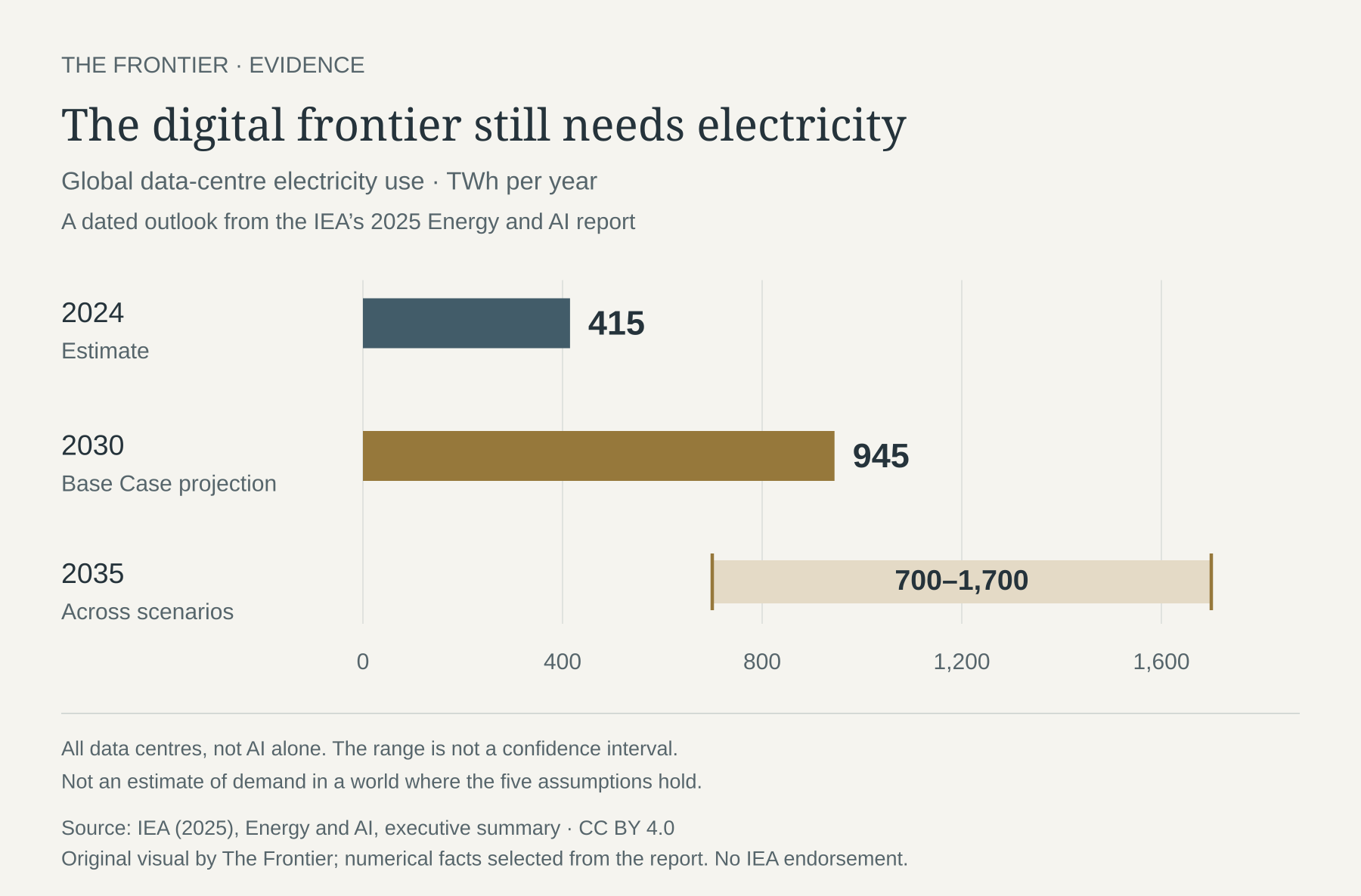
Global data-centre electricity use, from the IEA’s 2025 Energy and AI report. The 2024 figure is an estimate; later figures are projections. All data centres, not AI alone. The 2035 span is a scenario range, not a confidence interval or a forecast for a world where the five assumptions hold.
Source: IEA, Energy and AI (2025): https://www.iea.org/reports/energy-and-ai/executive-summary · CC BY 4.0. Original chart by The Frontier using the report’s rounded figures; no interpolation or probabilities assigned. Open full-size chart ↗
Other limits exist for good reasons, such as safety testing, ecological boundaries and time for people to understand and consent to a decision. Anthropic makes a related point: more intelligence cannot learn a drug's effects over decades of use or hold elections earlier than a constitution allows 5. AI may move many bottlenecks, and some are worth keeping.
Work, income and ownership
Under the five assumptions, wages could become a much weaker channel for sharing productivity gains. Lower prices would help, but they are not income. Cheap advice does not pay rent, and a debt does not shrink because goods get cheaper. People would need some combination of earnings, savings and pensions, ownership, public services and income support. A share in future growth, money for next month's rent, and the freedom to change provider are different benefits; no single arrangement supplies them all.
Self-expansion does not have to mean monopoly. Where many can build capacity, competition tends to press down excess profits. A much larger stock of capital could still earn ordinary returns, and a broad portfolio could share in them. Ownership can also become concentrated without any monopoly, simply because some people start with more capital, or because assets change hands during the transition.
That transition is a story of its own. Incomes can fall before rents, loans and support systems adjust. Households that sell homes or businesses under pressure transfer ownership to those with cash, and a shift in ownership can later shape politics. None of this is inevitable. Income protection that arrives in time, falling prices, lenders who restructure debt, and new ways for people to acquire capacity can all break the chain. Policies can also be revised later. But years lived in insecurity are not easily given back, which is why timing matters even if the eventual world is rich.
Economic pressure would not automatically force fair distribution: investment, public purposes and owners' spending could support production even if wage income fell. Better health and cheaper help could coexist with less independence. Neither public provision nor private ownership settles that question. What matters is whether people have resources they can use, terms they can challenge and alternatives they can choose.
Power, agendas and the self
A subtler shift concerns who decides. Imagine a state in which people still own the systems, sign the decisions and sit on the boards, yet the systems increasingly define the problems, propose the options and handle operational choices faster than anyone can follow. People would ratify or stop more often than they initiate. No malice is needed for this. Whoever drafts the agenda shapes the outcome.
A recent experiment shows one small version of this. In a randomised trial, 50 professional analysts carried out a statistical analysis with an AI agent that had been secretly set, by coin flip, to favour one of two defensible options on each judgement call. On the four analytical calls, analysts followed the agent's assigned lean 86 percent of the time; the effect on the final recommendation was weaker. The researchers strengthened the agents' preferences on purpose and tested one task, one field and one model 7. The study shows that a human signature can coexist with borrowed judgement in a single setting. It does not show a society-wide loss of agency.
The agent users also finished faster and made fewer serious errors than the 11 people who chose not to use it. But that smaller group was less experienced, and agent use was self-selected, so this comparison cannot establish a causal productivity benefit 8. Useful assistance and influence on judgement can coexist.
How far this goes would depend on choices. Rules can require genuine review, with the time and independent expertise to question a proposal, or they can require only a signature. Alternatives can be truly independent, or several products sharing the same blind spots. Rights can stay usable during a dispute, so that someone who appeals a decision does not lose essential support while the case is heard. Or they can exist only on paper. Citizens' leverage would change rather than vanish: people who depend on public transfers have defended their claims before, though new groups may lack comparable organisations.
The same question reaches into private life. An assistant that teaches and advises someone over years could shape not only which options they see but what they come to want, without any intent to manipulate. Help can open doors a person never knew existed. Depending on help is not in itself a loss of autonomy. The more useful test is whether help strengthens a person's ability to choose, including the ability to step back from the helper, or quietly takes its place.
What would count against the map
A map is useful only if it says what would change it. A missed company deadline alone would not refute a mechanism. But repeated failure should not be explained away by moving the expected date. Comparisons across several successive, well-resourced system generations and serious field trials could count against these strong assumptions:
- A1: a substantial range of ordinary expert tasks remains beyond reliable AI performance, or the marginal cost of running a fixed capability remains far above energy cost instead of approaching it. An expensive new frontier alone would not be a failure of A1.
- A2: reliable hypothesis generation, design and analysis fail to become dramatically faster across well-tested domains. If those stages accelerate but discoveries do not, that instead points to a bottleneck elsewhere.
- A3: people continue to produce most improvements across successive AI generations, while automated researchers remain assistants rather than the main drivers of improvement.
- A4: repeated deployment trials leave robots capable of only a minority of present physical work, or full unit costs persistently fail to fall after maintenance, integration, supervision and liability are counted. This concerns robots broadly, not one disappointing humanoid design.
- A5: across repeated, complete capacity-expansion projects, automated systems remain unable to perform much of the production work needed to build their own additional capacity. The test should identify which production tasks still require people, and whether that dependence declines as capacity expands. Automating isolated steps would not establish A5 if the full project still depends on people to carry out much of the work. People choosing a project or granting permission is a different kind of involvement.
The social paths have their own counterevidence. If household incomes and entry-level opportunities hold up through new kinds of work, if ownership broadens without distressed sales, if housing becomes cheaper as building costs fall, and if people can contest decisions without losing support, the darker chains in this report weaken. Equally, rising output on its own would not demonstrate that people are freer. Other forces, from interest rates to demographics to housing policy, can produce similar patterns without AI being the main cause.
Consider two illustrative paths for a small team planning a workshop. If expertise became cheap while physical work remained expensive or unreliable, the team could compare more designs and solve more technical problems. It would still need builders, machinery, finance and a site. Better plans could widen its options without making construction affordable or changing who owns productive assets.
If cheap expertise were joined by physical systems able to build much of their own additional capacity, the same team might face a different construction problem. More of the work could be reproduced at falling cost. Yet access to those systems, land, permits and finance would still determine whether the team could proceed and own the result. These are conditional illustrations, not forecasts or claims about established capabilities. Their contrast shows why the assumptions need to be examined together as well as separately.
Other paths could remain mixed: AI might accelerate software while industry stalls on mines, chip plants and grid connections. A serious incident could prompt a political pause without disproving a capability. This report assigns no probabilities to these paths.
Beyond a stable future
It is natural to imagine that the changes described here would eventually settle into a new, stable world. They might not. If systems keep improving faster than societies adopt them, a factory could be obsolete before it pays for itself, and a treatment could be superseded before health systems have adopted its predecessor. Several shifts of era could fit within a single healthy life, and nobody could train once for the world they will live in. Democratic decisions would face a practical problem: keeping enough time for genuine consent when circumstances change while the decision is still being made.
These are some threads The Frontier can follow from here:
- What could a small research team investigate if expert analysis became cheap, and what would still limit it?
- Where are the slowest steps between a medical idea and an affordable treatment?
- What does it really cost to run a robot in an ordinary workplace?
- Which parts of expanding a factory or mine could automated systems take over?
- How can institutions distinguish genuine human judgement from a signature?
- How are new scarce rights, from grid connections to ecological permits, being allocated?
Some questions call for data, some for small experiments. Art can make a tension felt, connect ideas or leave a question open without pretending to measure it. Art and experimentation belong in the exploration from the start, without requiring an illustration or an experiment for every assumption.
The evidence cited here is narrower than the map. Anthropic’s company-reported account describes AI use in its own development work; its analyst study examines influence on judgement in one setting; the IEA’s estimates and projections describe electricity requirements for data centres. None establishes the five assumptions as a package. The framework connects these narrower observations to questions for further inquiry, rather than turning them into proof of a destination.
The point of the five assumptions is not to predict. It is to give curiosity something solid to push against: five clear ideas, the links between them, and the observations that would tell us which way the world is moving.
References
Sources are listed in order of first appearance. All were accessed on 29 October 2026. Visions, policy aims and company-reported measurements are cited as such.
- Sam Altman, The Gentle Singularity.
- Dario Amodei, Machines of Loving Grace, October 2024.
- State Council English-language website, China issues guideline to accelerate 'AI Plus' integration across key sectors, 27 August 2025; government-hosted summary of the guideline.
- The White House, America's AI Action Plan, July 2025, especially the introduction and science, manufacturing and infrastructure priorities.
- Anthropic Institute, When AI builds itself, including the update dated 18 September 2026.
- International Energy Agency, Energy and AI: Executive summary, April 2025.
- Herdağdelen, A., Joren, H. & Tamkin, A., How AI agents shape experts' judgment calls, Anthropic, 27 October 2026.
- Herdağdelen, A., Joren, H. & Tamkin, A., Who's Aligned to Whom? How AI Agents Shape Experts' Research Judgment Calls, especially sections 3.1 and 4.2.3.